

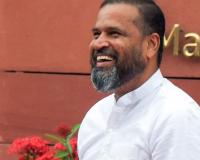
Balen Shah, who came to power this year following Nepal's Gen Z movement, is on his first bilateral foreign visit as Prime Minister. Before this, he had addressed the United Nations General Assembly in New York.
Experts believe the visit is particularly important because most of the political forces that emerged in Nepal following the movement are not made up of professional politicians. The visit therefore offers an important opportunity to build mutual understanding between the leadership of the two countries.
During Shah's India visit, discussions are expected to cover bilateral trade, climate change, air connectivity, tourism, energy and the border dispute. Union Minister of State Jitin Prasada welcomed Shah at the airport. On Monday, Shah is scheduled to meet Prime Minister Narendra Modi and President Droupadi Murmu. The two leaders will hold talks at Hyderabad House, following which several agreements are scheduled to be signed.
India and Nepal share an approximately 1,750-kilometre-long border adjoining Uttarakhand, Uttar Pradesh, Bihar, Sikkim and West Bengal. Most sections of this border operate under an open-border arrangement. Both countries are closely watching the outcome of Shah's visit.
Ranjit Rae, India's former Ambassador to Nepal, said the first priority for India should be to understand the new Nepali leader, given the limited familiarity between the two sides.
"The first thing that is important for India during this visit is that we should understand the new leader because we do not know him very well. However, there have been several visits over the past seven to eight months. Ravi Lamichhane, president of the Rastriya Swatantra Party (RSP), visited India, followed by his Foreign Minister Shishir Khanal. So, discussions have been continuing. This is the first meeting between the two Prime Ministers, which makes it very important," Rae said.
Since assuming power, Shah had maintained a policy of not meeting foreign leaders. However, experts believe the circumstances have now changed.
Rising fuel prices following the conflict involving the United States and Israel against Iran, shortages in fertiliser availability and the sudden flooding in Nepal's Bhotekoshi have created several challenges for Shah.
Shankar Sharma, Nepal's former Ambassador to India, said Shah had previously avoided foreign visits and extensive discussions with foreign leaders. He added that officials from both countries had worked extensively to prepare for the visit.
"However, a situation had also developed domestically in which it became clear that maintaining relations with other countries was extremely important for Nepal, particularly strengthening its relationship with India. After all, messages are exchanged through meetings between ambassadors and leaders of the two countries. Overall, such an atmosphere developed in Nepal that Shah changed his mind," Sharma said.
According to a report published by The Kathmandu Post, India has indicated a positive response to Nepal's proposal for $2 billion in grants and lines of credit. Discussions between the two countries on the proposal have reached the final stage.
Nepal is seeking a financial assistance package worth $2 billion, approximately Rs 17,000 crore, comprising grants and loans from India. It has also requested an additional air entry route through Indian airspace.
According to officials, India has adopted a positive approach towards the economic assistance proposal. However, the two countries have yet to reach an agreement on the additional air route.
Shankar Sharma said Nepal had previously received a line of credit worth approximately $800 million, equivalent to Rs 7,400 crore, but the entire amount could not be utilised. Nepal now wants the facility to be extended and is seeking a new financial package worth $2 billion, including both grants and loans.
"The floods in Bhotekoshi have caused extensive damage, so the assistance will also be useful for reconstruction. However, this grant is not limited to flood-related requirements. It also concerns other projects being developed through cooperation between India and Nepal," he said.
Airspace access is another important issue currently under discussion between the two countries.
Nepal's main international airport is located in the capital, Kathmandu. In addition, new airports have been constructed in Bhairahawa and Pokhara. Both airports were developed with the objectives of improving connectivity within Nepal and attracting international tourists.
Nepal maintains that the existing air-entry arrangements for these airports are creating operational difficulties.
The number of entry points available to international flights entering Nepal through Indian airspace is currently very limited. As a result, some aircraft have to follow longer routes, increasing their operational costs.
Speaking about the issue, Ranjit Rae said aircraft operations at both airports remained limited, with only a few domestic and international flights operating.
He pointed out that the Bhairahawa airport was built with a loan from the Asian Development Bank (ADB), and its contractor was also a Chinese company. China invested in the Pokhara airport, which was also constructed by a Chinese company.
"India's permission is required to make both airports successful and financially sustainable because aircraft arriving at and departing from these airports will use Indian airspace," Rae said.
Bhairahawa is located in Nepal's Rupandehi district, close to Uttar Pradesh. Lumbini, regarded as the birthplace of Lord Buddha, is also located in this region. Pokhara, meanwhile, is one of Nepal's prominent tourist destinations.
At present, most international flights entering Nepal have to use the Simara route in south-central Nepal, even when their destination is in the country's western region. This makes flight routes longer and places additional pressure on air traffic.
Rae explained that aircraft departing from either of the two airports would enter Indian airspace, while aircraft landing there would also have to pass through Indian airspace.
"Granting airspace permission is a technical and security-related issue. However, if Nepal has built these airports by taking loans and they do not operate properly, they will become a financial burden for the country. Nepal needs to resolve this problem, and if India can help, that would be welcome. A solution will have to be found," he said.
He also said the issue carried an important message for Nepal regarding future infrastructure projects.
"Going forward, whenever such infrastructure projects are undertaken, consultations should continue. If Nepal had discussed the matter with India in advance and obtained its consent, this problem would not have arisen in the first place," Rae said.
The border dispute is another issue that has remained under discussion between the two countries ahead of Shah's visit.
After taking office this year, Balen Shah made headlines with a statement that both Nepal and India had encroached upon each other's territory.
Following the controversy, Nepal's Ministry of Foreign Affairs issued a clarification, stating that the Prime Minister's remarks were not made in the context of territorial claims but concerned encroachment and land use along the Nepal-India border.
The dispute has its roots in India's release of a new political map in 2019, which showed Limpiyadhura, Kalapani and Lipulekh as part of Indian territory.
Nepal subsequently amended its Constitution and updated its national political map. The revised map included three strategically important areas—Lipulekh, Kalapani and Limpiyadhura—within Nepal's boundaries. India rejected Nepal's move as unacceptable.
With Balen Shah now serving as Nepal's Prime Minister, expectations have grown that the border dispute could be discussed afresh.
The key question is whether his visit could lead to a positive initiative towards resolving the long-standing disagreement.
Speaking to BBC News, senior Nepali political analyst Kanak Mani Dixit had expressed hope that the Nepalese Prime Minister would raise the border dispute during his visit to Delhi.
"I hope that this time Nepal's Prime Minister will raise the border dispute with Delhi. A solution may not emerge immediately, but discussions to resolve this problem should begin," he said.
Shankar Sharma said a committee was already working on cross-border holdings, with the objective of completing the process within three years.
However, regarding the disputes involving Susta, Lipulekh, Limpiyadhura and Kalapani, he said both countries had earlier agreed to initiate discussions through a Foreign Secretary-level mechanism. Although an understanding had been reached, no meeting had taken place since then.
Sharma believes the issue could be discussed during the meeting between the two Prime Ministers, although its inclusion in the joint statement is unlikely.
Nevertheless, he said the two leaders could discuss the matter and the conversation could send a positive signal.
Climate change is another significant issue expected to feature in the discussions.
Ranjit Rae said climate change had emerged as an important subject in the dialogue between India and Nepal.
During his address to the United Nations General Assembly, Balen Shah had proposed establishing a joint mechanism led by India, China and Nepal to address the Himalayan climate crisis.
Explaining the importance of regional cooperation, Rae said global warming and climate change were rapidly affecting the Himalayas, which are known as the Third Pole and the Water Tower of the region. Approximately two billion people depend on water originating from the Himalayas.
He warned that melting glaciers and collapsing rocks caused by global warming would affect not only Nepal but several other countries, including China and India.
"The Bhotekoshi floods show that climate change is not merely a multilateral issue but also a bilateral one. This is why climate change has become an important subject," Rae said.
With financial assistance, air connectivity, infrastructure development, climate change and the long-standing border dispute all forming part of the discussions, Balen Shah's first bilateral visit to India carries considerable importance for the future course of relations between the two neighbouring countries.
About The Author








Comment List